Protecting Client and Family Data in a Malaysian Care Home: A PDPA Guide
A care home holds some of the most sensitive information there is: diagnoses, medicines, photos of people at their most vulnerable, next-of-kin details and payment records. In Malaysia this is personal data under the Personal Data Protection Act 2010 (PDPA), and information about a person's health is treated as sensitive personal data, which carries stricter rules. This guide explains in plain words what changed in 2024 and 2025 and what a care home can do about it this month. It is a general guide, not legal advice.
What changed
The Personal Data Protection (Amendment) Act 2024 received royal assent in October 2024, and its provisions came into force in stages. The two that matter most to a care home came into force on 1 June 2025, and the Commissioner published guidelines on both in early 2025:
- A data protection officer. Published summaries of the guidelines say a controller or processor must appoint one if its processing involves personal data of more than 20,000 people, sensitive personal data (health information counts) of more than 10,000 people, or regular and systematic monitoring of personal data. A single care home with a few dozen clients may well fall below those numbers, but a group of homes may not. An officer, once appointed, must be notified to the Commissioner within 21 days.
- Telling the regulator about a data breach. If a breach causes, or is likely to cause, significant harm, or affects more than 1,000 people, the Commissioner must be told as soon as practicable and, according to the published summaries, within 72 hours. The people affected must be told without unnecessary delay and within seven days of the Commissioner being notified.
The detail, including exactly when the 72 hours starts and what counts as significant harm, is in the Commissioner's guidelines. Law firm summaries differ on some points, so read the current guidelines on the Commissioner's website before you write your own policy, and ask your legal adviser how they apply to your home.
Start by knowing what you hold
Make a one-page list of the personal data your home keeps and where each kind lives. Most homes find more places than they expected: paper files in the office, spreadsheets on a manager's laptop, photos on staff phones, WhatsApp groups with families, and one or more software systems. The list should cover four groups of people: clients, their families, your staff, and job applicants.
Keep access to the people who need it
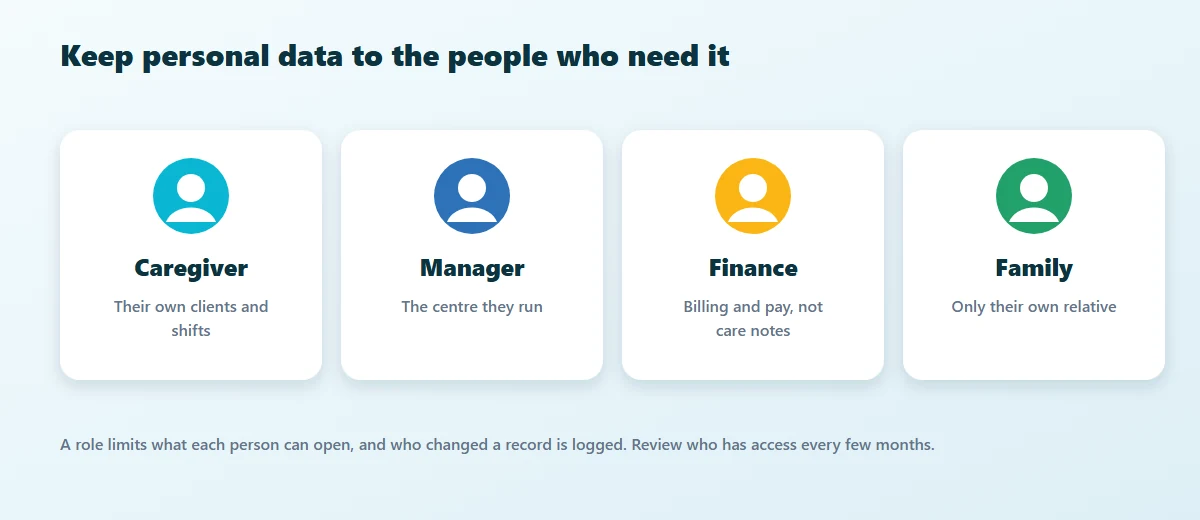
A caregiver does not need to see payroll. A finance officer does not need to read care notes. A family member should see only their own relative. Write down who has which level of access, give each person their own sign-in rather than a shared one, and review the list every few months and whenever someone leaves.
Photos and messaging apps
Photos of clients are personal data too. Record whether the client, or the family for a client who cannot decide, has agreed to photos being taken and shared, and check that before a photo goes to a family or onto a notice board. Personal phones and chat groups are the most common way client information leaks by accident, so agree a clear rule on what may be sent, to whom, and where it must not go.
Have a breach routine before you need one
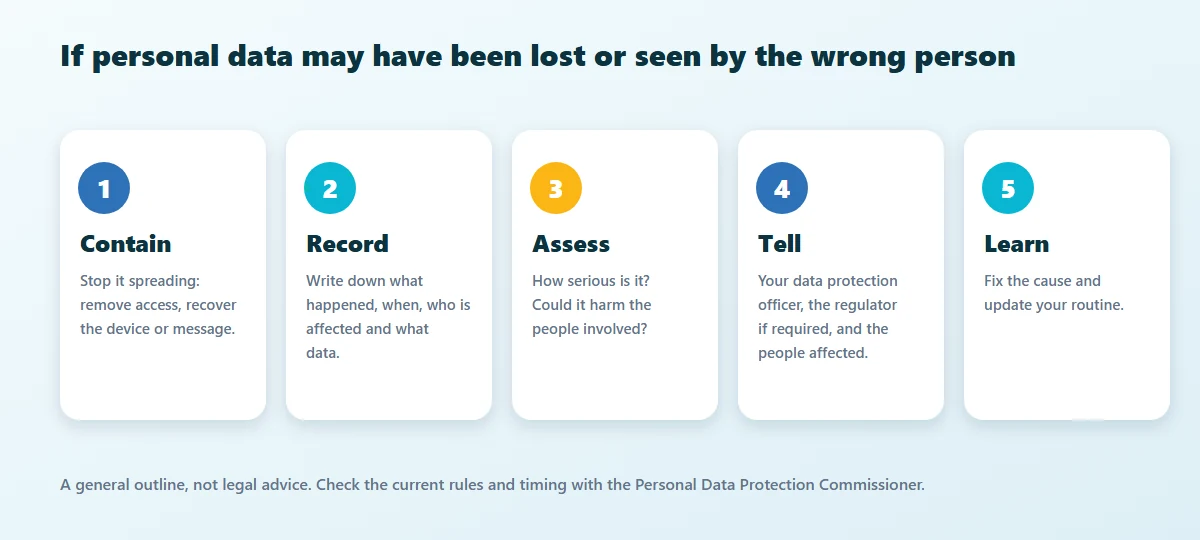
A breach does not have to be a cyber attack. A letter sent to the wrong family, a lost phone with client photos, or a spreadsheet emailed to the wrong person are all breaches. Decide now who is called first, keep a simple form to write down what happened, and practise the steps once so nobody is learning them in a crisis.
Appoint and train
Ask your legal adviser whether any of the three thresholds above applies to your organisation and, if you appoint a data protection officer, who in your home is best placed to do the job. Whatever the answer, train every member of staff, in a short session, on three things: what counts as personal data, what they must never share, and who to tell if something goes wrong.
What software can and cannot do
Good software helps: it limits who sees what, shows who changed a record, and keeps one record in one place instead of many copies on many phones. It cannot replace a policy, training or a responsible person. When you compare systems, ask where the data is stored, who at the vendor can see it, whether you can see who opened or changed a client record, and how you can get your data out.
For reference, Life Care Systems stores a care home's records on servers in Singapore, has levels of access from caregiver and family up to administrators, limits a family account to its own relative, shows photos only where the client's photo consent is recorded, and gives administrators an audit log of who did what and when. Read the details on our security and privacy page.
This month's checklist
- Write the one-page list of the personal data you hold and where it lives
- Give every person their own sign-in and remove access for people who have left
- Record photo consent, and set a rule for photos and messaging apps
- Write a one-page breach routine and name who is called first
- Check the current Commissioner guidelines and ask your adviser whether you need a data protection officer
Further reading
This article is general information, written on 21 November 2026, and is not legal advice. Dates and requirements can change.
Try it with made-up data
You can try Life Care Systems free for 7 days in a practice centre with made-up clients, then decide.