Safer Medication Rounds in a Care Home: What to Check Before, During and After
A medication round is the busiest and most important part of a shift. Most problems come not from carelessness but from missing information: an allergy buried in a file, a dose given twice by two people, a late dose nobody noticed, or a paper chart that was not updated until the end of the shift. This guide sets out a simple routine you can use with paper or with software. It is general information; your own medication policy, your pharmacist and your qualified clinical staff always decide.
Where rounds go wrong
- Safety information is hard to find. Allergies, fall risk and do-not-resuscitate status sit in different places, so they are read late or not at all.
- Two people, one dose. One staff member gives the dose and another gives it again because the record was not yet updated.
- Late and missed doses go unnoticed until the next shift reads the chart.
- Records are written afterwards, from memory, at the end of the round.
- A weak signal or a missing paper chart means a dose is given but not recorded.
Before the round: look at the safety information first
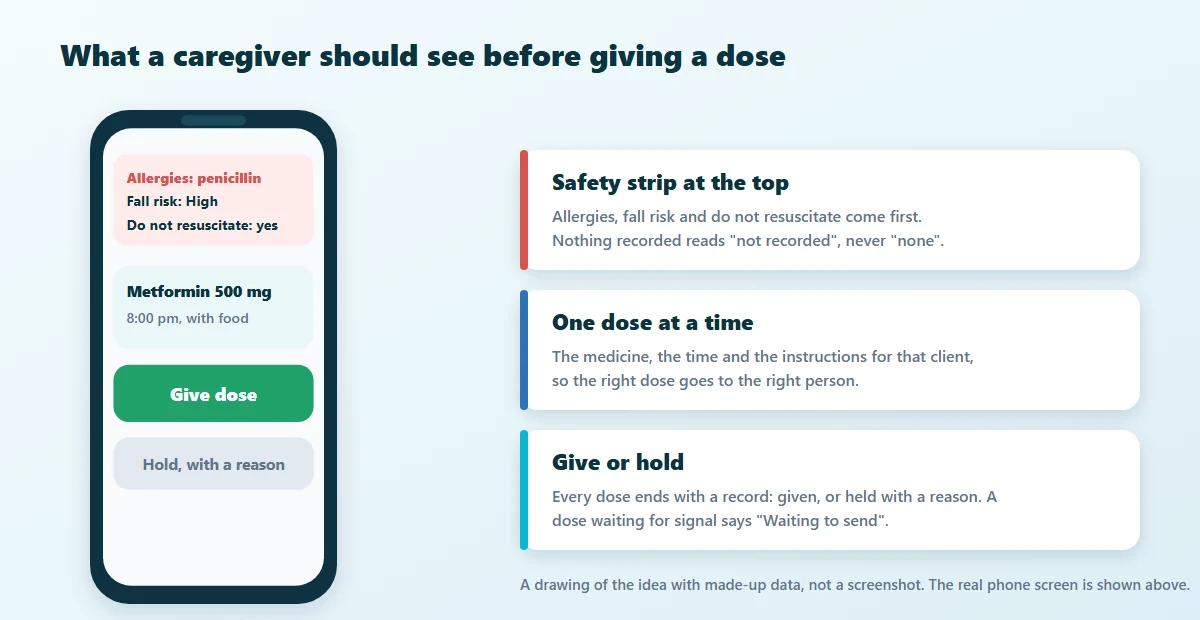
Before you open the first dose, read the safety information for the client: allergies, fall risk and do-not-resuscitate status. If nothing is recorded, the screen or chart should say "not recorded", never "none" or "low", because a blank can be mistaken for a clear answer.
During the round: one client, one dose, one record
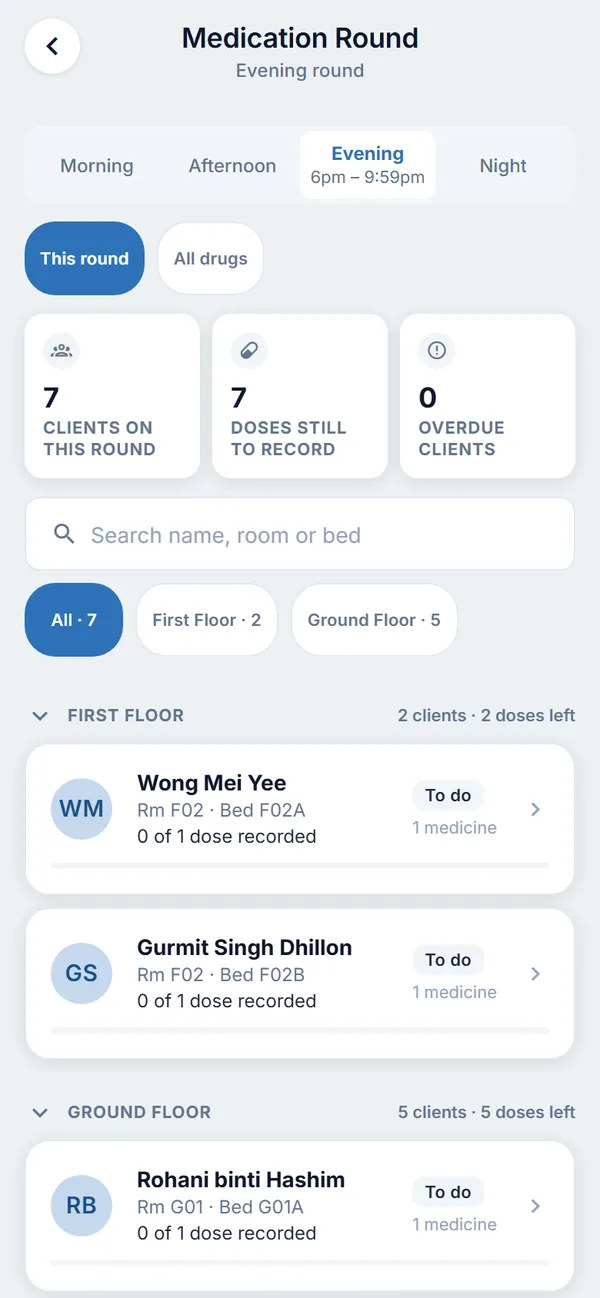
A widely taught check is the "five rights": the right client, the right medicine, the right dose, the right route and the right time. Add a sixth habit: the right record. Record each dose at the time you give it, not at the end, and if you hold a dose, record the reason.
Where two people can record the same dose, agree a rule for who gives which round, and have a way to catch duplicates before both are accepted as true. The person who made a record should not be the person who decides which of two conflicting records stands.
After the round: late doses and handover
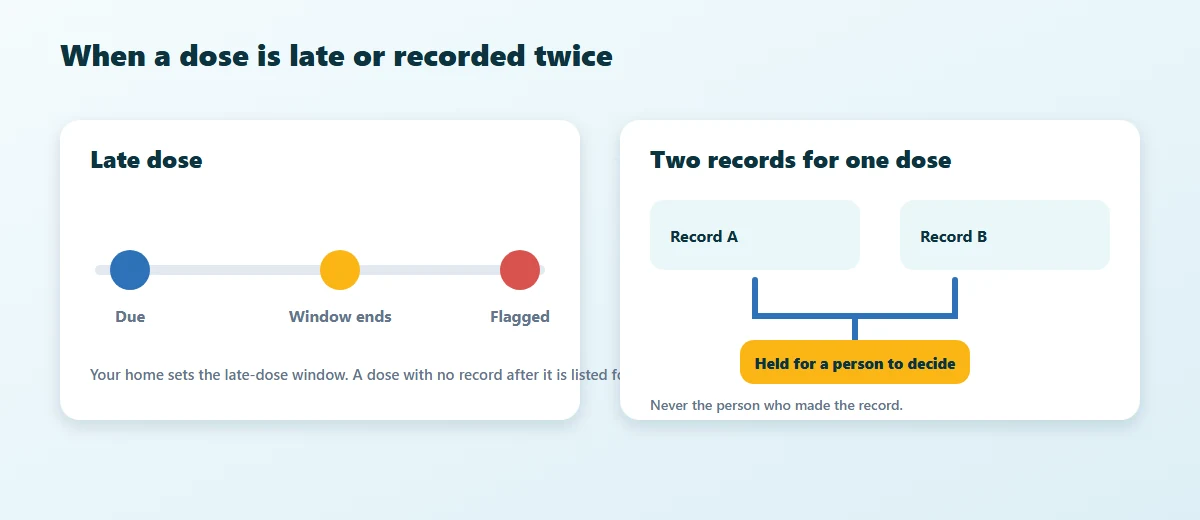
Set a late-dose window for your home with your clinical lead, and check every dose with no record once the window has passed. Then use the handover to tell the next shift about held doses, refusals and anything unusual, so the next person starts with the facts rather than the chart.
What software can and cannot do
Software can put the safety information in front of the caregiver, keep records with their original times, flag late doses and hold duplicates for a person to decide. It cannot give medical advice or make a clinical decision. Those stay with your qualified staff.
In Life Care Systems the safety strip (allergies, fall risk, do not resuscitate and infection) shows at the top of the client screen, on the medication round and when adding a medicine. Doses, vital signs, notes and photos are kept on the phone with their original times and sent, oldest first, when signal returns; a dose waiting to be sent says "Waiting to send", never "Given". If two records for the same dose arrive, both are held and the team leader on shift, a manager or an administrator decides, with a reason; nobody decides their own record. Only authorised administrators can change a prescription. Read more on the medication safety page.
Key takeaways
- Read the safety information before the first dose, every time
- Record each dose when you give it, and give a reason when you hold one
- Decide a late-dose window, and check every dose with no record after it
- Do not let one person both make and settle a conflicting record
- Use handover to pass on held doses and refusals
Try it with made-up data
Ask for a free 7-day test account and run an evening medication round in a practice centre with made-up clients.